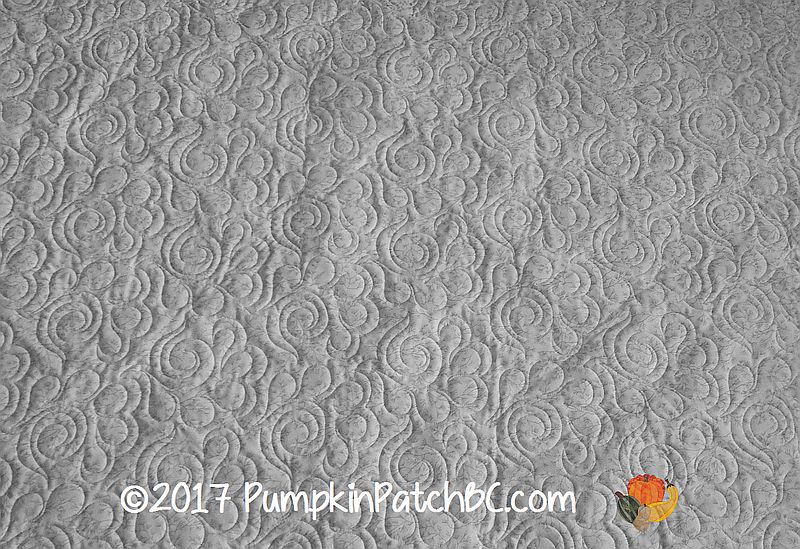
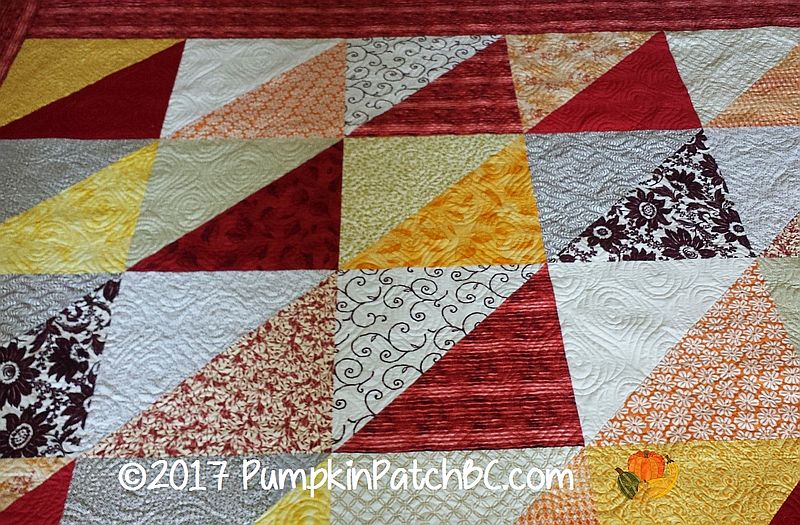
Joanne made this quilt top that she calls “Shattered Dishes”, a fun variation of the traditional Broken Dishes block. For quilting she chose the pantograph “Swirling Feathers”, also a very traditional design that complements the pieced triangle blocks well. Isn’t it amazing what you can do with “just” half-square triangles?
Diesen Quilt hat mir Joanne zum Quilten gebracht. Sie nennt ihn “Shattered Dishes”, die Blöcke sind eine Variation des traditionellen Blocks “Broken Dishes”. Als Quiltmuster hat sie die “Swirling Feathers” gewählt, ein ebenfalls traditionelles Muster, das auch hier die geometrischen Blöcke gut ergänzt. Es ist doch immer wieder beeindruckend, was man aus “nur” Half-Square Triangles so alles machen kann.
Here is another scrappy quilt pattern to use up all those leftovers that keep piling up. Amber Johnson of Gigi’s Thimble wrote a tutorial with lots of pictures. Her version uses only red, blue and aqua but it works equally well with scraps of all colours. For the centres you will need 2″ squares, and the half-square triangles for the star points use 4 1/2″ squares. Or you could also change the pattern a little and make a four patch from 3 1/2″ squares for the centre of the star… that’s what I would have to do since I am *really* running low on 2″ squares after all my scrappy projects this year. It is a very versatile pattern, so be sure to check it out.
Hier ist ein weiteres Tutorial für einen Scrap Quilt, um all die Reste zu verwenden, die sich immer ansammeln. Amber Johnson/Gigi’s Thimblehat die Anleitung geschrieben, auf Englisch, aber mit vielen Bildern. Für ihre Version hat sie nur rot, blau und türkis verwendet, aber das Muster eignet sich wunderbar für Reste in allen Farben. Für die Mitte werden 2″ Quadrate verwendet, die Dreiecke für die Sternenspitzen entstehen aus 4 1/2″ Quadraten. Oder man könnte auch aus vier 3 1/2″ Quadraten ein Four Patch für die Mitte nähen, das würde ich vermutlich tun, da ich mittlerweile kaum mehr 2″ Quadrate herumliegen habe, nach all der Resteverwertung in diesem Jahr. Es ist ein vielseitig verwendbares Muster, Abspeichern lohnt sich.
This is another of Ginger’s quilts that she asked me to quilt for her. If you are wondering where the monkey in the quilt name is coming from, the pieced blocks go by many names, and one of them is “Monkey Wrench”. The other popular name you might have come across is “Churn Dash”. I quilted one motif in the pieced blocks and another in the alternating squares and chose a third motif for the blue border squares. A quick and easy fun project!
Dies ist ein weiterer Quilt, den ich für Ginger gequiltet habe. Wer sich fragt, woher der Name “Monkey Business” kommt… der gepatchte Block in diesem Quilt ist unter vielen verschiedenen Namen bekannt, und einer davon ist “Monkey Wrench”. Ebenfalls sehr bekannt ist die Bezeichnung “Churn Dash”. Gequiltet habe ich zwei verschiedene Motive abwechselnd in den gepatchten Blöcken und den hellen Quadraten sowie ein drittes Motiv in den blauen Blöcken des äußeren Randes. Das war ein schnelles Projekt, das viel Spaß gemacht hat.
Cindy made this quilt as a gift for her daughter Kalei. We chose the pantograph “Peacock Feathers” since this design looks very nice on rectangular blocks. Cindy didn’t just piece the top, she also made large half-square triangle blocks from the leftover fabrics for the backing which turns this into a reversible quilt. I love the colour combination, and the fabric with the peace signs is my favourite.
Diesen Quilt hat Cindy als Geschenk für ihre Tochter Kalei genäht. Als Quiltmuster haben wir die “Peacock Feathers” (Pfauenfedern) ausgesucht, die passen immer so gut zu rechteckigen Blöcken. Und Cindy hat nicht nur das Top gepatcht, sondern aus den restlichen Stoffen auch Half-Square Triangles genäht und daraus die Rückseite zusammengesetzt, so dass der Quilt nun beidseitig verwendbar ist. Die Farbkombination gefällt mir richtig gut, und besonders schön finde ich den Stoff mit den Peace Zeichen.
Another month has come and gone, this time it seemed to be really fast since I was away for half of May. I had originally planned a bug for June but when I started playing around with ideas I couldn’t make it work. So I tried a butterfly instead, and that design came together quickly. My first draft used cool blue colours but it didn’t look like summer, so I changed the colours to red, orange and yellow. For quilting I tried to follow the butterfly colours for texture with large flowers as the focus in the centres of the wings. The background is quilted with free motion butterflies and loops. As always, the link for the free download can be found at the end of this post.
Und wieder ist ein Monat vorbei. Diesmal kam mir die Zeit besonders kurz vor, da ich ja den halben Mai gar nicht hier war. Eigentlich hatte ich für Juni einen Marienkäfer geplant, aber da wollte mir das Design so gar nicht gelingen. Also bin ich dann auf Schmetterling umgeschwenkt, und das zeichnete sich dann schon fast von selbst. Der erste Entwurf war allerdings in kühlen Blautönen, das sah sehr elegant aus, aber nicht wirklich sommerlich, also habe ich die Farbpalette dann auf rot, orange und gelb umgestellt. Beim Quilten habe ich wieder versucht, den Schmetterlingsflügeln Struktur zu geben, und die großen Blumen erschienen dann irgendwie wie von selbst. Der Hintergrund ist mit freihändig gequilteten Schmetterlingen gefüllt. Das Muster gibt es wie immer zum freien Download.
Edit: Das Muster ist im März 2019 in den Shop umgezogen und kann dort erworben werden.
Edit: The pattern moved to the store in March 2019. If you missed the free download, you can still purchase it there.
Jodi Nelson made this sweet little baby quilt and wrote a tutorial for Moda Bake Shop. She used a charm pack to make her pinwheels but of course using up leftovers from your stash works equally well. Jodi came up with a very creative detail that makes this quilt special: she added Prairie Points to an inner border. Prairie Points, in case you are not familiar with the term, are folded fabric triangles that are usually added to the outer border of a quilt instead of traditional binding. But of course they can go anywhere on a quilt, as Jodi’s Pinwheel Baby Quilt shows.
Dieser süße Babyquilt wurde von Jodi Nelson genäht, und die Anleitung gibt es als Tutorial beim Moda Bake Shop (auf Englisch, aber gut bebildert). Sie hat für die Blöcke ein Charm Pack verwendet, aber wie immer lassen sich natürlich auch eigene Reste dafür gut verarbeiten. Jodi hat das einfache Muster mit einem sehr kreativen Detail aufgepeppt, indem sie Prairie Points in einem inneren Rand verarbeitet hat. Wer mit Prairie Points nicht vertraut ist, das sind gefaltete Dreiecke aus Stoff, die sonst eher außen herum einen Quilt verschönern, anstelle eines traditionellen Bindings. Aber wie Jodi hier zeigt, können Prairie Points selbstverständlich überall in einem Quilt verwendet werden.
This gorgeous quilt was made by Brenda, using a Batiks Jelly Roll by Laundry Basket Quilts. I love the vibrant colours and the secondary design that appeared after putting the blocks together. The pantograph Brenda chose is called “Flourish”, and the pretty swirls enhance the beauty of the pieced top.
Diesen wunderbaren Quilt hat Brenda genäht und dafür eine Batik Jelly Roll von Laundry Basket Quilts verwendet. Die leuchtenden Farben sind genau richtig für mich, und gut gefällt mir auch das sekundäre Muster, das durch das Zusammensetzen der Blöcke entstanden ist. Das Quiltmuster, das Brenda gewählt hat, heißt “Flourish”, die Kurven und Swirls wirken auf den klaren Linien des Tops besonders schön.
Carol made these Ohio Star Quilts for her daughters, one in red and one in blue. She wanted them quilted the same way and chose the design “Turbulence”. It is one of my go-to designs for geometrical blocks, and once again it worked really well. The Ohio Star is one of my favourite traditional blocks, and I enjoyed working on Carol’s quilts very much. These quilts will be lovely gifts for her daughters.
Diese beiden Ohio Star Quilts hat Carol für ihre Töchter genäht, einen in rot und einen in blau. Sie wollte sie gern beide gleich gequiltet haben und wählte als Muster “Turbulence” aus. Das kurvige Muster funktioniert ja immer gut mit streng geometrischen Blöcken, und auch diesmal war es keine Ausnahme. Der Ohio Star ist einer meiner liebsten traditionellen Blöcke, und das Quilten von Carols Quilts hat mir viel Spaß gemacht. Ihre Töchter freuen sich sicher über dieses wunderbare Geschenk.
This quilt was made by Maureen using lovely green and brown batiks. It is a gift for her son who loves being outdoors. When we talked about how to quilt it, she wanted to go with the nature theme and was thinking of leaves. I asked how she felt about bears and suggested the pantograph “Deer in the Woods”. It has moose and elk and bears and trees, and I think it’s just perfect for this quilt. It was fun quilting all the different animals, and it will be a lovely gift.
Diesen Quilt hat Maureen genäht und dafür grüne und braune Batikstoffe verwendet. Er ist für ihren Sohn bestimmt, der gern wandert und sehr naturverbunden ist. Sie wollte für das Quiltmuster auch beim Thema Natur bleiben und fragte, ob ich ein Design mit Blättern hätte. Ich hatte beim ersten Blick auf den Quilt sofort das Muster “Deer in the Woods” vor Augen, mit Bären, Hirschen, Elchen und Bäumen. Ich finde, es ist für ihren Quilt einfach perfekt. Und es hat Spaß gemacht, die verschiedenen Tiere zu quilten. Ein sehr schöner Quilt, der bei dem Beschenkten sicher großen Anklang finden wird.
It was pretty clear from the beginning that the May wall hanging would feature a flower. I just wasn’t sure what kind. I am not familiar with “the” mayflower (trailing arbutus), and the pictures I found didn’t really inspire me. Besides, the word “Mayflower” always makes me think of Plymouth Rock and the Pilgrim Fathers, and not an actual flower. After I abandonded this idea, being German made the rest rather easy. The German name for Lily of the Valley translates to “Little May Bells”, and I have always loved these flowers. I am quite happy with the way my Lily of the Valley turned out, and I had fun playing with textures and different fillers to quilt it. I even quilted a Lily of the Valley design on the tan background! The link for the free pattern download can be found at the end of this post.
Dass das Motiv für Mai eine Blume sein sollte, war mir schon relativ früh klar, allerdings wusste ich nicht so recht, was für eine. Es gibt eine Blume, deren englischer Name “Mayflower” ist, aber die ist mir persönlich noch nicht begegnet, und die Bilder, die ich gefunden habe, fand ich aufgrund der doch offenbar sehr kleinen Blüten nicht sehr inspirierend. Und außerdem muss ich bei “Mayflower” immer an Plymouth Rock und die Pilgerväter denken. Nachdem ich diesen Gedanken dann verworfen hatte, bin ich zu meinen deutschen Wurzeln zurückgekehrt und habe mich für ein Maiglöckchen entschieden. Aus deutscher Sicht ist das absolut naheliegend, der englische Name “Lily of the Valley” enthält leider keine Mai-Referenz. Aber Maiglöckchen habe ich schon immer geliebt, also habe ich mich ans Werk gemacht und bin mit dem Ergebnis auch ganz zufrieden. Beim Quilten hatte ich Spaß mit verschiedenen Strukturen und Füllmustern, und auf dem beigen Hintergrund habe ich sogar Maiglöckchen gequiltet. Der Download-Link findet sich wie immer ganz am Ende des Posts.
Edit: Das Muster ist im März 2019 in den Shop umgezogen und kann dort erworben werden.
Edit: The pattern moved to the store in March 2019. If you missed the free download, you can still purchase it there.